Country
World

Author
YASIROV Films
How Gen Z and TikTok Are Rewriting the Wedding Film
Updated
How Gen Z couples and TikTok are changing wedding films: what couples now expect, the rise of the wedding content creator, and what it means for filmmakers.
Through 2026, The Knot, Zola and wedding-culture outlets like Nice News and Wedded Wonderland kept returning to the same subject: Gen Z weddings. The story isn't really about a single viral clip. It's about a generational handover. Gen Z now makes up a large and growing share of couples getting married, and the people who photograph and film weddings are adjusting as it happens.
A different kind of couple
Zola's 2026 First Look Report, based on a survey of more than 11,500 couples, is the first in which Gen Z is the majority of respondents, at 51 percent. The Knot's 2026 Real Weddings Study, which looks at US weddings from the year before, puts Gen Z at 41 percent of the market. The exact figure depends on the sample, but the direction is clear.
Some of their habits look familiar. Compared with millennial couples, Gen Z respondents in Zola's survey were more likely to have a wedding party (92 percent against 79), religious customs (54 against 38) and a bouquet toss (40 against 29). Other habits are new. Nineteen percent of couples said they were in full planning mode before they were technically engaged, and 10 percent toured venues before a proposal. Reddit use for wedding inspiration nearly tripled, from 3 percent in 2025 to 9 percent in 2026, while Pinterest still leads at 77 percent.
What ties it together is a taste for the unpolished over the perfect. Vintage décor, organic florals, mocktail menus and warm, earthy palettes come up again and again in the 2026 trend coverage. The Knot's Gen Z trend report, written by associate editor Chapelle Johnson, describes the same shift in how weddings are recorded: camcorder-style footage, Super 8-style home movies projected at the reception, and documentation that feels like real life rather than a highlight reel staged for an audience.
What TikTok trained couples to expect
That preference has a clear source. Half of all couples in Zola's 2026 survey got wedding inspiration from TikTok, up from 41 percent a year earlier, and 60 percent of Gen Z couples did. The platform has spent years turning specific wedding moments into shareable templates, and couples now arrive at their own weddings with a mental shot list drawn from someone else's video.
Wedded Wonderland's May 2026 roundup of the most-repeated formats includes the "morning after," where newlyweds film themselves waking up, walking through the aftermath of the party or eating leftover cake, and "before the aisle," which captures the private minutes before a ceremony starts, often paired with a dress reveal. Others are built around audio. Couples reveal their ceremony entrance song in a clip of the actual walk down the aisle, and reaction videos set to trending sounds have become their own genre.
As that article puts it, the common thread is that "they do not feel staged for perfection. They feel alive." That's a real shift for anyone filming weddings professionally. It isn't a rejection of craft. It's a rejection of the idea that craft has to look composed.
The rise of the dedicated content creator
One result has been a new role on the vendor list, somewhere between photographer and social media manager. In a 2023 Toronto Life profile, creator Vanessa Buonaguro described the business she built around this gap, Dear Diary Social. She films on an iPhone, hands over 700 to 1,000 raw videos and photos per wedding, and delivers three to five short edited videos after about 48 hours of editing, starting at $1,500. She said about 90 percent of her clients aren't very active on social media. Most "scroll but rarely post," and simply want a fast, honest record of the day alongside their photographs.
The Knot's reporting on Gen Z couples shows the same pattern more widely: content creators hired for vertical video, "roaming reporter" guest interviews and confessional booths running through the reception. Zola's numbers back it up. Forty percent of couples who want social content ask their professional photographer or videographer to include it in the shot list, and 21 percent plan to create their own social-first content on the day.
So the wedding video is now asked to do two jobs at once. One is the traditional job: a well-shot, well-cut film that still holds up on your tenth anniversary. The other is new: a same-day or next-day piece for a phone screen and a short attention span.
On Lake Como this has become a service of its own. Como Content Creator covers the vertical, same-day side of a wedding alongside the film team, and their note on what a wedding content creator actually does is the clearest explanation of where the two roles meet.
What it means for the people behind the camera
Videography studios now routinely list a short social highlight and vertical versions among their 2026 trends. What hasn't changed is what couples value most in the long run. The part of a wedding film people return to is the sound: the vows, the speeches, a parent's voice. A phone clip rarely captures that well, and it's the part we put the most care into.
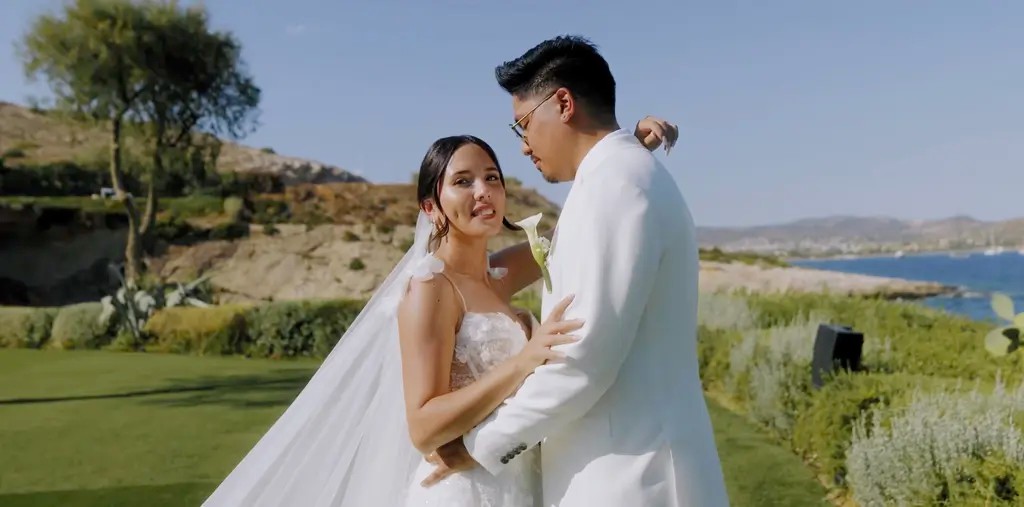
The picture is less about TikTok replacing traditional wedding films and more about both formats sharing the same shot list. A couple at a destination wedding still wants the wide, cinematic footage of a ceremony against a lake or a coastline, like the films in our portfolio. They may also want a 30-second cut of the day to post before the week is out. Studios that treat both as part of the same job, rather than treating the second as an afterthought, are the ones best placed for where Gen Z couples are heading.
How to plan for both on your wedding day
If you want a cinematic film and fast social content, a few decisions early on make the day easier.
- Decide who shoots what. If you hire a content creator as well as a videographer, introduce them before the wedding. Agree who covers the ceremony from which position, so the creator's phone doesn't end up in the middle of the film's key shots.
- Ask your videographer about vertical versions. Ask what formats they deliver, how long the social cut is and when it arrives. Vertical framing has to be planned while filming rather than cropped afterward.
- Keep the ceremony unplugged. A short announcement asking guests to put phones away keeps the aisle clear and faces visible. Content can happen after the ceremony.
- Pick one or two trends, not ten. Choose a format you actually like, such as a "before the aisle" moment or a morning-after clip, and tell your team in advance. Chasing a long list of trends turns the day into a production.
- Sort out the music. Films use licensed music. If you want a trending sound on TikTok or Instagram, you usually add it yourself in the app when you post.
- Check venue rules at destination weddings. Some venues limit drones, extra crew or filming in certain rooms, and some set a hard stop on music. Share the venue's rules with every person filming.
For small weddings and elopements this matters even more, because every person with a camera is a large share of the room. Our guide to eloping on Lake Como covers small celebrations in more detail, and the Lake Como destination guide goes through a full wedding day.
How we handle vertical and social formats
Every highlight film we make is delivered in two versions: horizontal for a TV or laptop, and vertical for your phone and social media. You don't need to ask for it: it's part of every wedding we film.
If you want more than that, we can put together a custom package on request with 10-15 short vertical clips shot on our cameras rather than a phone. We're also preparing a dedicated social package. Tell us early if you're interested, because vertical clips need their own framing on the day.
At YASIROV Films our style is calm and documentary: no staging, minimal equipment and a strong focus on audio. Weddings start from €4,500 and elopements from €1,500. If you'd like to talk about how your film and your social content can work together, get in touch.
FAQ
What is a wedding content creator?
A person hired to film the day on a phone and deliver short, social-ready videos within hours or days. They don't replace a videographer: they produce quick vertical clips, while a videographer produces a full edited film with professional sound.
Do we need both a videographer and a content creator?
Not necessarily. Zola found that 40 percent of couples who want social content ask their photographer or videographer to include it. If your videographer can deliver a short vertical edit, one team may be enough. If you want many clips on the same day, a separate creator makes sense.
How much does a wedding content creator cost?
Prices vary widely by market. In the Toronto Life profile, Dear Diary Social started at $1,500. Destination weddings usually add travel costs.
What are the most popular wedding TikTok trends in 2026?
Among the most repeated formats are the "morning after" clip, the "before the aisle" moment, the aisle walk with the entrance song revealed, and reaction videos set to trending sounds.
How do we get a same-day reel without phones everywhere during the ceremony?
Hold an unplugged ceremony and let one person, your content creator or videographer, capture the vertical footage. Guests can film freely from the aperitivo onward.
Do you deliver our wedding film in vertical format?
Yes. We always deliver the highlight film in both vertical and horizontal formats. On request we can also add 10-15 short vertical clips shot on camera.
Sources
- 2026 Wedding Trends Spotlight: Gen Z and TikTok, Nice News
- The New Viral Wedding TikToks Taking Over 2026 Weddings, Wedded Wonderland
- Gen Z Wedding Trends in 2026, Spotted by Our Gen Z Editor, The Knot
- The Knot Worldwide Unveils 2026 Real Weddings Study, The Knot Worldwide
- "Couples hire me to recreate TikTok trends": Meet a full-time wedding content creator, Toronto Life
- Wedding Videography Statistics 2026, Soul Motion
- Gen Z Enters the Wedding Chat: Zola Releases 2026 First Look Report, PR Newswire
- The First Look Report 2026, Zola