Country
Italy
Location
Italy

Author
YASIROV Films
Italian Wedding Traditions: What They Mean and How to Include Them
Confetti, la serenata, making the bed, the tie cutting, the tarantella and the old superstitions: what Italian wedding traditions mean, how they differ by region, and which ones work at a destination wedding.
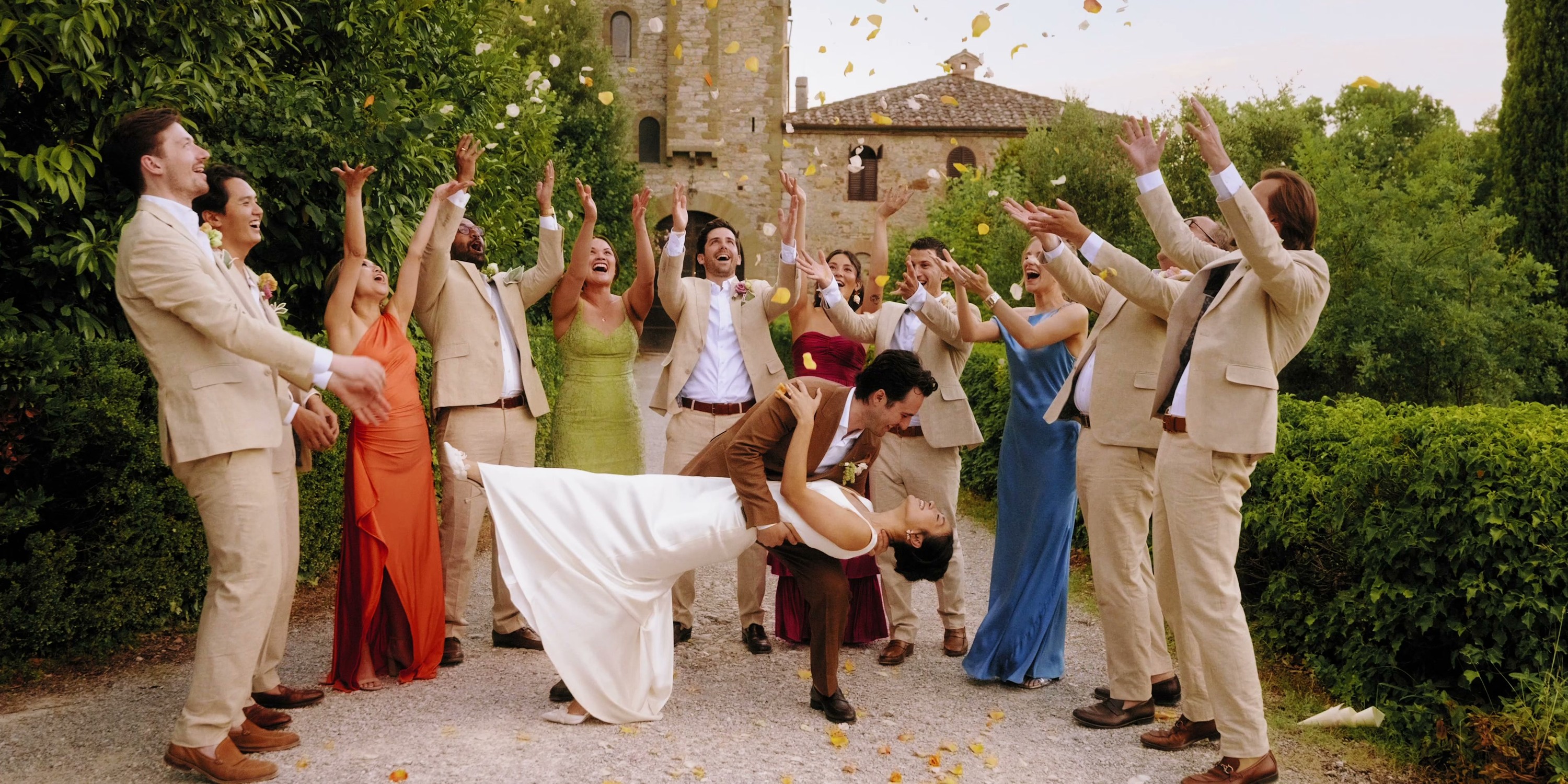
Italian wedding traditions are less about one fixed ceremony and more about a set of small customs that families repeat, change and argue over from town to town. Sugared almonds in odd numbers, a serenade under the bride's window, the groom's tie cut into pieces, rice at the church door, a proverb about Tuesdays and Fridays: most Italians know them, and each region keeps its own version.
We film weddings in Italy for couples from abroad, and many of them ask which of these customs they can borrow. This guide explains what each tradition means, where it comes from when that is known, how the North and the South differ, and how the traditions look on film. Where an origin story is popular but not proven, we say so.
What are the most important Italian wedding traditions?
The traditions most Italians still recognize are confetti (sugared almonds) in the favors, the bomboniera itself, rice thrown at the couple, the groom not seeing the dress, the serenade the night before, the bride's bed prepared by friends, the cutting of the groom's tie, the tarantella in the South, and money envelopes as gifts.
Not every family does all of them. A wedding in Milan or on Lake Como often keeps only the confetti and the rice, while a wedding in Puglia, Calabria or Sicily can include most of the list, with a reception that lasts many hours.
What do confetti and bomboniere mean?
Confetti are sugared almonds, not paper. They are given to guests in a bomboniera, a small favor, and tradition asks for an odd number, usually five, standing for health, wealth, happiness, fertility and long life. Italian wedding guides repeat the meaning of the five; the odd number is the older rule.
A few details that often surprise couples from abroad:
- The word: in Italian, "confetti" are the almonds. Paper confetti are "coriandoli". If you ask an Italian venue for confetti, they will think of sweets.
- The color: white for weddings. Silver and gold confetti belong to the 25th and 50th anniversaries.
- Where they come from: Sulmona, in Abruzzo, is the town most associated with confetti. Confetti di Sulmona are listed by the Italian agriculture ministry as a traditional food product.
- The bomboniera: a small keepsake (a box, a ceramic piece, a bag of tulle) with the almonds inside, handed out by the couple at the end of the meal. Everyone gets the same favor.
- The confettata: in many southern weddings, a table or buffet of confetti in different flavors appears late in the evening.
What happens the night before an Italian wedding?
The night before, the couple traditionally sleep apart in their family homes. In central and southern Italy the groom may bring musicians and friends to sing a serenade under the bride's window, and in Sicily and Calabria the bride's friends prepare the couple's marriage bed a few days before.
La serenata
The serenade is a medieval custom that stayed common in the South until after the Second World War. The groom, sometimes with professional musicians, sings or plays under the bride's balcony while her family and neighbors listen. Today it is often a party in the street with a small band, and sometimes it ends with food and wine offered by the bride's family.
Making the bed
In Sicily the custom is called "cunzata ro liettu" (dressing the bed); in Calabria a very similar one is the "vestizione" of the bed. A few days before the wedding, unmarried friends of the bride make the bed with the best embroidered linens from her trousseau, while mothers, aunts and cousins watch. Confetti are arranged in hearts or in the couple's initials, and traditionally rice and coins went under the sheets for luck. The couple are not supposed to see the bedroom before the wedding night, and today the friends usually add a few pranks.
What traditions happen during the ceremony?
A Catholic church wedding and a civil one follow different rules, but some customs appear in both: the bride arrives a little late (around 15 minutes is considered fine), the groom has not seen the dress, and rice is thrown as the couple walk out. If the rings fall, the officiant picks them up, not the couple.
In a civil ceremony, the officer must read three articles of the Italian Civil Code to the couple, numbers 143, 144 and 147, about the mutual rights and duties of spouses, family life and the duties towards children. Article 107 of the Civil Code sets this out, together with the two witnesses. For a church wedding with civil effect, the priest reads the same articles. Many destination couples find this the most "Italian" moment of a civil ceremony, because it is read in Italian and then translated.
After the ceremony:
- Rice: a symbol of abundance and fertility, thrown at the couple at the church or town hall door. Many couples now use petals or soap bubbles instead.
- Noise: car horns and tin cans on the car, once meant to scare off evil spirits, now just a lot of noise through the village.
- Breaking a plate or glass: in parts of the South a plate is broken at the bride's feet as she leaves home or the church. The number of pieces is said to equal the couple's years of happiness.
- Petals and the bouquet: in southern families the mother-in-law sometimes hands the bride her bouquet, and the bride leaves home on her father's arm.
What happens at an Italian wedding reception?
An Italian reception is a long meal first and a party second, with many courses, toasts and the shout of "Evviva gli sposi!". Two customs give it its character: the cutting of the groom's tie, mostly in the North, and the tarantella, the circle dance of the South.
Il taglio della cravatta (cutting the tie)
Il taglio della cravatta is a reception custom in which the groom's tie is cut into small pieces and sold to guests. The money goes to the couple, often towards the honeymoon. It is mostly found in northern Italy, and it is less common than it was, but it still appears at many weddings.
How it usually goes: late in the evening, the best man or a friend takes the groom's tie, cuts it with scissors on a tray, and walks between the tables. Guests pay what they like for a piece. In some versions a bigger offer buys a longer piece. Some websites call it an ancient Roman tradition against evil spirits; we found no historical source for that, and Italian wedding sites mostly treat it as a modern fundraising game.
It works well at a destination wedding, because it gets guests laughing and moving between tables. Tell the groom in advance, so he wears a tie he is willing to lose.
La tarantella
La tarantella is a fast folk dance from southern Italy, mainly Campania, Calabria and Puglia, also danced in Sicily. Guests form a circle, hold hands and spin faster and faster as the music speeds up. It has long been danced at births, engagements and weddings in the South.
The origins are disputed. One popular story links the name to the city of Taranto and to "tarantismo", a folk belief that the bite of a tarantula could be cured by frenzied dancing. Other scholars point to much older dances of Greek southern Italy. Neapolitan tarantella as most people know it today took shape in the 18th century.
At a northern wedding a tarantella is usually a single set played by the band. At a wedding in Naples or Calabria it can come back several times during the night, and grandparents often dance it better than anyone.
Which Italian wedding superstitions do people still follow?
The best known are about the date. "Di Venere e di Marte né si sposa né si parte" says you should neither marry nor travel on Friday (Venus) or Tuesday (Mars). May has a bad reputation, and in Sicily so does August. Rain on the day is good luck: "sposa bagnata, sposa fortunata".
Tuesday and Friday
Few Italians plan a weekday wedding on a Tuesday or a Friday, partly because of the proverb, partly out of habit. Friday is also linked to fasting and penance in Christian tradition. Italian wedding portal Matrimonio.com lists a meaning for every weekday, from Monday for health to Wednesday as the luckiest working day.
May and August
The aversion to May is old. Ovid wrote in the Fasti that common people said bad women marry in May, and Roman marriages were not held during the Lemuria, the days in May dedicated to the restless dead. A Sicilian proverb says a May bride will not enjoy her "cuttunina", the quilt in her trousseau, meaning the marriage will not last. The folklorist Giuseppe Pitrè recorded in 1889 that Sicilians had considered May and August unlucky months for weddings since at least the 18th century, as Balarm explains. May is also the month of the Virgin Mary for Catholics, and some families say a bride should not take the spotlight from her.
In practice May is a popular wedding month today, especially on the lakes.
Sunday
Many English articles say Sunday is the luckiest day for an Italian wedding. It was once the preferred day, but many parishes now avoid Sunday weddings because the day belongs to the Sunday Masses. Saturday is by far the most common day today, even though old sayings call it unlucky.
Rain: sposa bagnata, sposa fortunata
"A wet bride is a lucky bride." The saying comes from rural Italy, where rain meant a good harvest and so fertility and abundance. Italians say it to every couple whose wedding is rained on, usually with a smile. On Lake Como, where a spring or autumn shower is likely, guests will say it to you.
Smaller superstitions
- The bride does not look at herself in the mirror fully dressed; she leaves one accessory off until the last moment.
- Something old, new, borrowed and blue exists in Italy too, often with a gift from family added.
- February 29 is avoided because of the proverb "anno bisesto, anno funesto" (leap year, unlucky year).
The wedding soup myth
Italian wedding soup is not served at Italian weddings. "Italian wedding soup" is an Italian American name that comes from a mistranslation of "minestra maritata", the "married soup" of southern Italy. The marriage is between the meat and the green vegetables in the broth, not between two people. In Naples it is a dish for Christmas and Easter, and you will not find it on a wedding menu.
The version known in the United States, with small meatballs and pasta in chicken broth, is a different dish altogether. If your guests expect it, it can make a fun late-night course, but an Italian caterer will probably smile at the request.
How do traditions differ between the North and the South?
The broad difference is scale. Southern weddings tend to be larger, longer and more rooted in family ritual, while northern weddings are often shorter, with more couples choosing a civil ceremony. Inside both halves every province has its own customs.
- Northern Italy (Lombardy, Veneto, Piedmont, Lake Como): shorter receptions, the tie cutting, confetti and rice, gift lists or a honeymoon fund. Civil ceremonies are common, often in historic town halls and villas.
- Southern Italy (Campania, Puglia, Calabria, Sicily): big guest lists, many courses, the tarantella, the serenade, the making of the bed, the confettata. Money envelopes ("la busta") are the standard gift, often expected to cover at least the cost of the guest's meal.
- Local examples: in San Costantino Albanese in Basilicata, an Arbëreshë community, the couple receive a ritual bread called cugliaccio, shaped as two rings forming a nest. In Sicily the "fuitina", when a couple ran away together to force their families to accept the marriage, is remembered as a story more than a practice.
- The seating plan: in many regions tables spread out from the couple's table by closeness and age, with parents and grandparents first.
Which Italian traditions can destination couples include?
Most couples marrying in Italy from abroad pick three or four customs that feel natural and leave the rest. The easiest are confetti in the favors, rice or petals after the ceremony, the reading of the Civil Code articles in a civil ceremony, the tie cutting and a tarantella with the band. A serenade the night before works if your hotel allows music late.
A few practical notes:
- Confetti favors: order them from a confetti maker in Sulmona or through your planner, and print a small card explaining the five meanings for your guests.
- Rice and petals: many villas and some churches do not allow rice or paper on their terraces and steps, because of cleaning or the gardens. Ask the venue before you buy anything; dried petals are usually accepted.
- A serenade: book a small acoustic group for the evening before, at the hotel where the bride stays. Check the hotel's rules on music after 22:00.
- The tie cutting: works best after the first dance, when everyone is relaxed. Decide where the money goes and say it out loud.
- The tarantella: ask the band to teach it in a short demo first. Foreign guests join in quickly once they see the steps.
- The envelope: Italian guests may bring a busta even at a destination wedding with a gift list. A small box at the welcome table helps.
If you are still choosing where in Italy to marry, our guides to wedding locations in Italy and Lake Como wedding venues can help, and for a smaller ceremony see eloping in Italy.
How do Italian wedding traditions look on film?
The traditions are some of the best moments in a wedding film because they are unscripted: nobody poses during a tarantella or while a tie is auctioned between tables. What they need is a little planning, so the camera is in the right place.
- The serenade: night, often lit only by a doorway or street lamps. We bring small lights and agree a spot where the groom will stand, so the bride on the balcony and the musicians below are both in frame.
- The rice or petals: this lasts about ten seconds. Tell us where the couple will come out and ask guests to throw when you are on the steps, not after.
- The Civil Code reading: a quiet moment with good sound. We put a microphone on the officiant, so the words can be used in the edit.
- The tie cutting: loud, funny and full of reactions. It gives us guests' faces we would not get any other way.
- The tarantella: fast circles and spinning; we film from inside the circle with a small stabilized camera and from above, if the room allows.
- Confetti and bomboniere: detail shots during getting ready, before the tables are set.
Traditions also work as a structure for the film: a serenade the night before can open the story, and a tarantella at midnight can close it. For more about how we plan wedding days, see our Lake Como wedding guide.
FAQ
What do the five sugared almonds mean at an Italian wedding?
They stand for health, wealth, happiness, fertility and long life. Tradition asks for an odd number of confetti in each favor, and five is the most common. They are white for a wedding and are handed out in the bomboniera at the end of the meal.
Why do Italians cut the groom's tie?
To raise money for the couple. The tie is cut into pieces and sold to guests, and the money usually goes towards the honeymoon. The custom is mostly northern Italian and is a game more than a ritual.
What day is unlucky for an Italian wedding?
Tuesday and Friday, according to the proverb "di Venere e di Marte né si sposa né si parte". Many Italians still avoid them for a weekday wedding. May and, in Sicily, August were also once considered unlucky months.
Is rain on the wedding day good luck in Italy?
Yes. "Sposa bagnata, sposa fortunata" means a wet bride is a lucky bride. The saying comes from rural Italy, where rain stood for a good harvest, fertility and abundance.
Do Italians give money as a wedding gift?
In much of southern Italy, yes: an envelope with money (la busta) is the usual gift. In the North gift lists and honeymoon funds are more common, though money is accepted everywhere.
Can non-Italian couples use Italian wedding traditions?
Yes, and Italian vendors are usually happy to help. Confetti favors, rice or petals, the tie cutting and a tarantella fit any wedding. Check venue rules for rice and late music first.
Filming your Italian wedding
We film weddings across Italy, with travel included in Italy and Switzerland, and we are glad to help you plan where the traditions fall in your day so they end up in the film. A €1,000 deposit per filming day secures your date. Tell us your date, venue and the customs you are thinking of through our contact page.
Other stories you may like

Grand Hotel Tremezzo Wedding: Cost, Reception and Venue Guide
What a Grand Hotel Tremezzo wedding costs, where the ceremony and reception can happen, how many guests fit, and how the west shore light and Villa Carlotta next door shape the day.

Villa La Cassinella Wedding: Rental, Guests and Planning on Lake Como
What a Villa La Cassinella wedding involves in 2026: the exclusive-use rental, guest numbers, boat-only access, the new ownership and what to ask the villa before you plan.