Planning a wedding in Tuscany
Tuscany asks something different of a wedding film than a lake or a coastline does. There's no water to catch the light and throw it back twice — instead, the light here is filtered, slowed down by cypress rows, stone walls, and hills that hold onto haze until mid-morning. Couples who choose this region are usually choosing texture over spectacle: a private garden avenue over a grand hotel terrace, an old stone façade over polished marble.
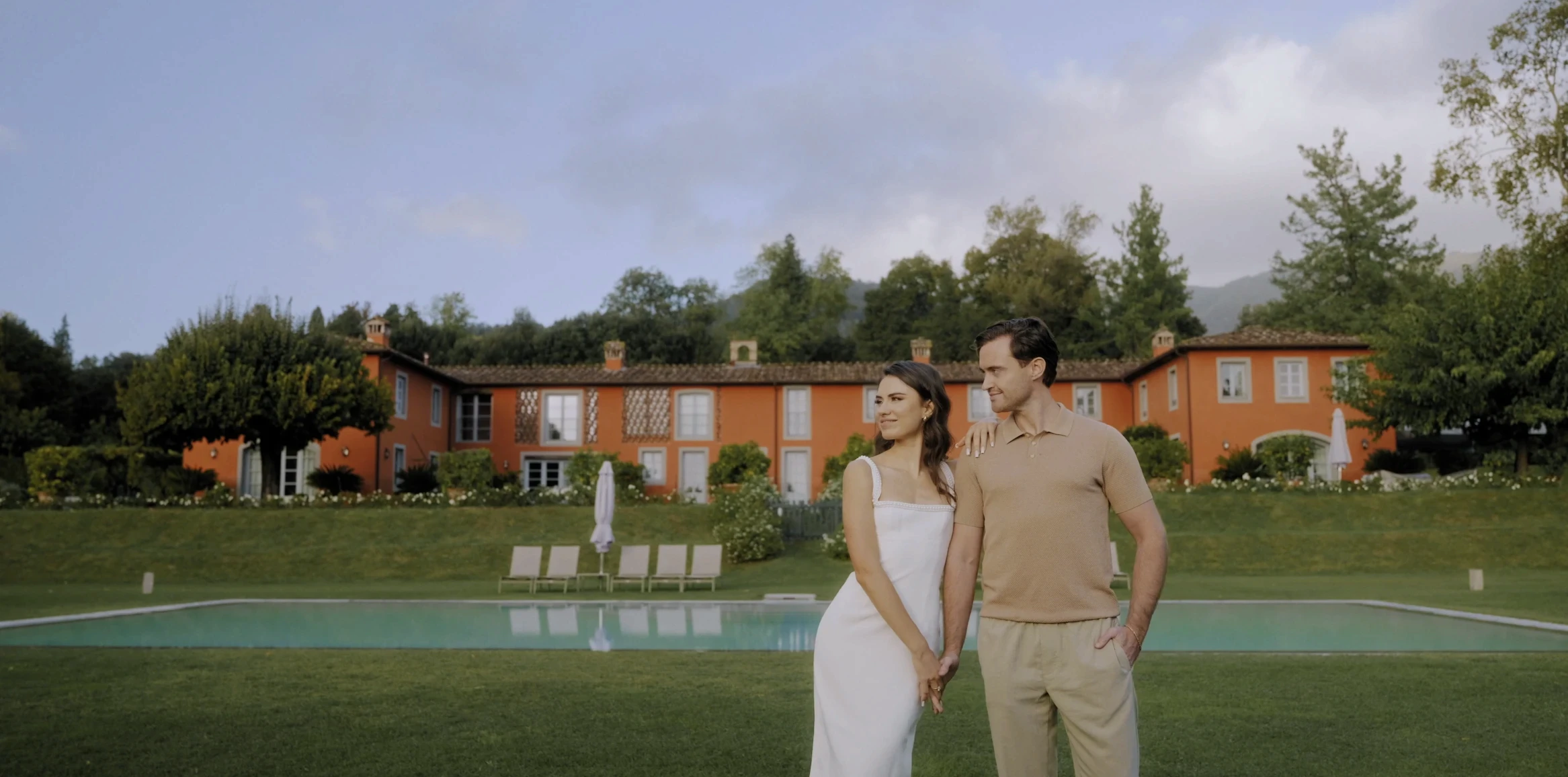
This guide is built from our own experience filming Eoghan and Dominyka's wedding along the garden avenue of Villa Grabau, near Lucca, combined with what we've learned working across Italy about how this region's light, seasons, and logistics actually behave on camera.
Why Tuscany asks for a different filming approach
On the lakes, we often work with reflected light and a fixed horizon — the water does a lot of the visual work for us. The land itself is the subject: rolling, uneven, constantly shifting in tone as the sun moves across it. That means our documentary approach — observing rather than directing, letting a moment happen once and filming it as it happens — depends even more on reading the terrain in advance. Where does the light fall at 4pm on the terrace where you'll say your vows? Which direction does the garden avenue face for the walk after the ceremony? These are the questions we work through before a Tuscany wedding day even starts, because there's rarely a second take once golden hour has passed behind a hill.
Villa Grabau: filming from experience
Villa Grabau, just outside Lucca, was where we filmed Eoghan and Dominyka's wedding — and it taught us a lot about how this region differs from the lakes we usually work.
Light consideration: The garden avenue at Villa Grabau runs long and straight, framed by centuries-old trees that filter the afternoon sun into moving patterns on the ground rather than flat light. It's a gift for a documentary approach — the light itself creates rhythm as the wedding party walks through it, without anyone needing to be positioned or paced by us.
Cinematic approach: Because the avenue is the villa's strongest visual feature, we resisted the temptation to over-shoot it early. We saved our widest, steadiest shots of the walk for when the couple actually moved through it during the day — guests trailing behind, the light already low — rather than staging a separate walk-through earlier for coverage. The result feels like something that happened once, because it did.
Logistics and flow: Villa Grabau's garden is large enough that guests naturally spread out between the lawn, the avenue, and the villa's interior rooms across the afternoon. We treated this as an advantage rather than a challenge — moving quietly between groups rather than gathering everyone into one tight frame — which kept our presence unobtrusive on a day that already had a slow, unhurried rhythm to it.
Other well-regarded venues in the region
Beyond Villa Grabau, Tuscany has no shortage of venues couples consistently gravitate toward, each suited to a different kind of day. We haven't filmed at the venues below ourselves, but they come up often enough in couples' shortlists that they're worth knowing about if you're still choosing where to marry:
Val d'Orcia estates (around Villa La Foce and similar properties) — known for their formal Italian gardens set against the region's most recognizable rolling hills. This area suits couples who want the classic postcard Tuscan landscape as a backdrop, with more open, expansive light than Lucca's shaded avenues.
Chianti's hilltop castles (such as Castello di Meleto and similar fortified estates) — stone courtyards and vineyard views, generally more dramatic and vertical in feel, with dusk light that turns the surrounding vineyards deep gold.
Siena-area borghi (like Borgo Santo Pietro) — restored medieval hamlets that host a single wedding at a time, often built around a working garden or estate, which tends to give the whole day a quieter, more private atmosphere.
If you already have a venue shortlist, send it to us before you book. We'll tell you honestly how the light and layout there tend to work on film, based on what we know of the area even where we haven't shot there ourselves.
Tuscany vs the lakes: a different kind of Italian wedding
Couples often ask us how to choose between a Tuscany wedding and one on Como or Garda, where most of our work happens. The honest answer is that they photograph and film differently, not just look different. On the lakes, the water gives you a constant, bright reference point — ceremonies tend to face it, and the light bounces up as much as it comes down. In Tuscany, the light comes from one direction only, the land is uneven underfoot, and venues tend to sit further apart from each other, so a Tuscany wedding often involves more travel between where you're staying, where you marry, and where you celebrate. What you gain is depth: layered hills instead of a single horizon line, and interiors — frescoed rooms, stone cellars, converted barns — that hold their own character on film rather than serving as a backup to the view outside.
Working with Tuscan light and the seasons
July and August are the hottest months, and heat changes how a wedding day moves — guests slow down, an outdoor ceremony at 1pm becomes uncomfortable rather than romantic, and the midday light goes flat and hard rather than warm. Most couples we talk to choose early June or the stretch from late August into October instead, when the light softens earlier in the evening and, from September, the countryside starts turning gold with the harvest. Rain is more likely outside the June–August window, so if your date falls in shoulder season, it's worth building a real indoor setting into the plan — not as a fallback you hope to avoid, but as a second location that can look just as good on film. Tuscan interiors, from frescoed villa rooms to stone cellars, hold light and atmosphere just as well as the gardens do.
What a Tuscany wedding film costs
For a full wedding day in Tuscany, our wedding films start from €5,000, with the final price depending on the number of hours covered, whether additional events (a welcome dinner, a farewell brunch) are included, and the final deliverables — a short film, a longer documentary cut, or both. Travel and accommodation for our team are included for weddings anywhere in Italy. Beyond the videographer's fee, it's worth budgeting separately for venue exclusivity and for transport if your ceremony and reception sit in different towns, which is common in this region.
Planning timeline and local logistics
Twelve to eighteen months is the realistic window for a Tuscany wedding, particularly if you have a specific villa or borgo in mind — the most sought-after properties, and the vendors who know them well, book out early for June and September dates. A local wedding planner is worth having for most international couples, not because we need one to do our job, but because Italian paperwork, vendor coordination, and moving guests between a villa, a church, and a reception venue are genuinely easier to manage with someone on the ground. If you're marrying legally in Italy, the required documents differ by nationality, and a planner who has handled this before will save you weeks of correspondence.
A few practical things are easier to settle early:
Drone coverage. Tuscany's hilltop properties and vineyards often carry specific airspace or estate restrictions. We check and clear this ahead of time so aerial footage doesn't become a last-minute scramble.
Multi-location days. If the ceremony and reception sit in different towns, we build travel time into the schedule so nothing gets rushed through.
Guest accommodation. Not our area directly, but worth flagging to your planner early — Tuscany's best venues often sit outside town centers, and guests appreciate clarity on where they're staying well before the wedding week.
Frequently asked questions
Is Tuscany a good choice for a documentary-style wedding film? Yes — the region rewards an observational approach particularly well. Long, directional golden-hour light and architecture with real texture give a documentary film room to breathe, though it depends more on advance planning than a lakeside wedding does, since there's no water to fall back on for light.
How is filming in Tuscany different from Lake Como or Lake Garda? Mainly in light and layout. The lakes give us a bright, reflective horizon and venues clustered close together. Tuscany's light is more directional and changes with the terrain, and venues tend to sit further apart, so we plan travel and timing more deliberately.
How many days should we book a videographer for? Most couples book a single wedding day. For multi-day celebrations — a welcome dinner, the ceremony, and a farewell brunch — some couples add coverage for the additional events, which we build into the package rather than pricing separately per day.
Can international guests get married legally in Tuscany? Yes, but the required paperwork depends on nationality, and timelines vary. This is one of the main reasons couples marrying from abroad choose to work with a local planner rather than handle it independently.
Do you travel to Tuscany often? We're based on Lake Como and travel across Italy and Europe for weddings, including Tuscany — Villa Grabau, near Lucca, is where our own Tuscany work has taken us so far. Get in touch and we'll share more on availability for your dates.
Planning a Tuscany date? Get in touch and we'll walk you through timing, logistics, and what a film at your venue could look like.
— Anton & Sabina