Country
Italy
Location
Rome

Author
YASIROV Films
Rome Wedding Videographer: Cinematic Films
Updated
A Rome wedding videographer's guide to filming in the Roman countryside and the city: villas, Campidoglio civil ceremonies, permits, drone rules, timing, and what a documentary wedding film looks like here.
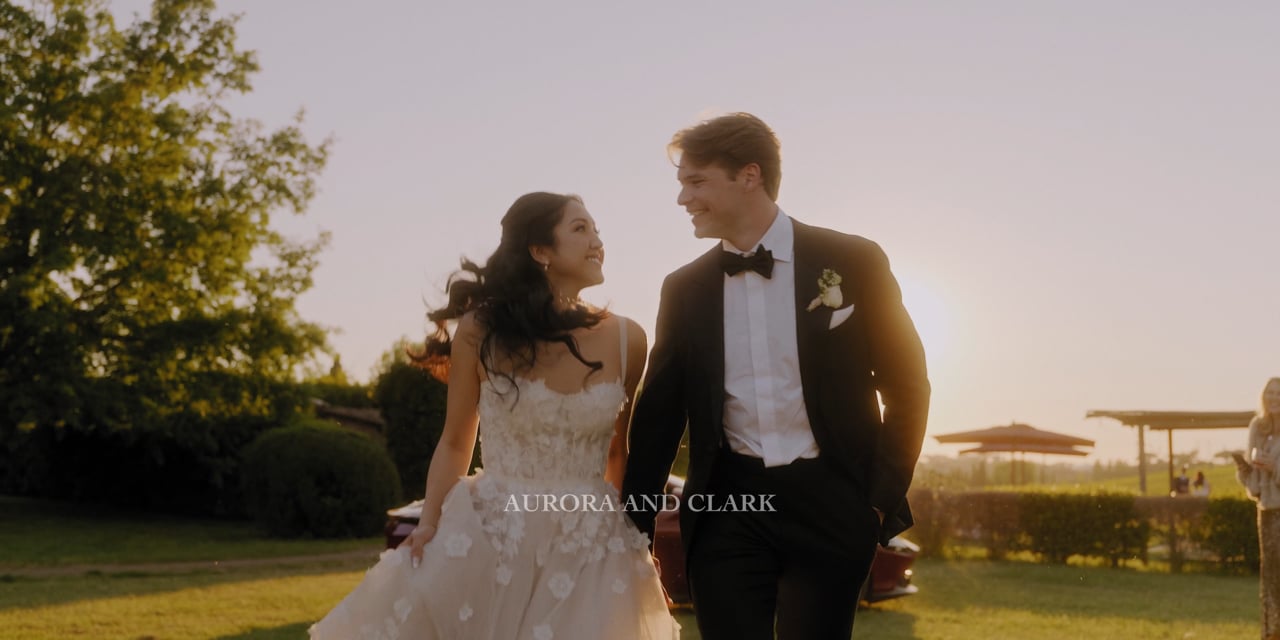
Aurora and Clark got married at Casale del Gallo, just outside Rome, on an evening when the light held on for what felt like an extra hour. We filmed their ceremony under the pergola, the reception inside the casale's stone walls, and a quiet moment before dinner when Clark saw the venue lit up for the first time. A string quartet played through cocktail hour, the dancefloor came alive after midnight with Paolini Allestimenti's lighting rig, and somewhere in between a Ferrari Roma pulled up the gravel drive for a few photos. It's the kind of wedding that reminds us why we keep coming back to Rome: the countryside around the city has a warmth and a scale that's hard to find anywhere else in Italy. You can watch Aurora and Clark's film here.
Why Rome works for a documentary wedding film
Rome is several looks, not one. Couples marrying here might choose a restored casale in the Roman countryside, a formal garden inside the city, or a rooftop with the dome of St. Peter's in the distance. That range is part of what makes filming here rewarding: we're rarely repeating the same frame twice.
The light is generous for most of the year, and the golden hour over the Roman hills has a particular warmth that suits documentary filming. We can work with natural light through the ceremony and most of the reception without forcing anything. Rome also draws an international guest list, and a city with this much history in the background gives a wedding film a sense of place that a generic ballroom never will.
Where couples marry around Rome
Most of the weddings we film happen outside the city center, in the countryside that surrounds Rome: restored casali and estates with olive groves, cypress-lined drives, and enough space for a marquee or an open-air reception. Casale del Gallo, where Aurora and Clark married, is one of these, with a pergola for ceremonies and stone interiors that hold candlelight well after dark. It sits about 15 km from central Rome (around 25 minutes by car), 5 km from Ciampino airport and about 30 km from Fiumicino, which makes it easy for guests flying in.
Inside the city, couples sometimes choose a historic villa or a garden with views over the rooftops. A smaller number plan a short session in the historic center itself: the Spanish Steps at dawn, or a quiet street near the Pantheon before the city wakes up. These city sessions take more planning than a countryside wedding, and they produce some of the most distinctive footage we shoot all year.
Getting legally married in Rome: the Campidoglio
The best-known place for a civil wedding in Rome is the Sala Rossa inside the Campidoglio, the city hall on the Capitoline Hill designed around Michelangelo's piazza. Roma Capitale also celebrates civil weddings in other municipal rooms, including the Sala Vignola Mattei by the Baths of Caracalla.
What to know before you plan around it:
- Fees depend on residency. At the time of writing (2024 figures), the Sala Rossa fee when neither partner lives in Rome is €1,392 on weekdays and €1,624 on Saturdays and Sundays, set by Roma Capitale's council resolution no. 436 of 31 December 2023. Rome residents pay much less. We found no newer tariff published for 2025 or 2026, so check the current fee with Roma Capitale's wedding office (Ufficio Matrimoni) when you book.
- The ceremony is short. A civil ceremony usually takes 20 to 30 minutes, is conducted in Italian, and needs two adult witnesses. If you don't speak Italian, you'll need an interpreter.
- Slots are fixed. The hall runs a schedule of weddings, so you can't stretch the timing or wait for better light. Guest numbers are limited by the room size.
- Paperwork comes first. Each foreign partner needs a nulla osta (a declaration of no impediment to marriage) from their embassy or consulate, plus certified and translated documents, and the requirements differ by nationality. Allow several months and use a planner or agency that handles Rome civil weddings regularly.
For a film, the Campidoglio works well as a short, formal chapter: the ceremony in the hall, then the steps of the Cordonata and the piazza outside, with the reception somewhere else. Many couples instead sign the legal papers at home and hold a symbolic ceremony at a villa or casale, which gives complete freedom over timing, language and setting.
Permits and filming at Rome's landmarks
Filming in Rome's historic center is not the same as filming in a private villa. Different authorities manage different places:
- Public streets and piazzas are managed by Roma Capitale, which issues permits for filming on public land. What you need depends on how the shoot uses the space (crew size, tripods, lighting, blocking a passage).
- Monuments and archaeological sites owned by the city, such as the Imperial Forums area and the Capitoline Museums, need an authorization from the Sovrintendenza Capitolina for commercial photography and filming, with a fee set each year.
- State sites such as the Colosseum and the Pantheon are run by the Ministry of Culture, and St. Peter's Square is Vatican territory. Each has its own rules for professional filming.
- The Trevi Fountain has had a €2 ticket for access to the area right by the basin since February 2026, roughly from 9am to 10pm (from 11:30am on Mondays and Fridays). The square above stays free and open, and there's no ticket after 10pm.
- The Spanish Steps can't be sat on: a city rule in force since 2019 bans it and local police enforce it. A standing portrait is fine; a picnic-style shoot on the steps is not.
In practice, that means planning any landmark session well in advance, keeping the crew small, and choosing the hour carefully. Early morning, before 7am in summer, is when these places are close to empty. If a specific Roman landmark matters to you, tell us early and we'll work out what's allowed there and what it takes.
Private estates and casali are more straightforward: the venue grants filming access as part of the booking, and we coordinate timing directly with the venue coordinator.
Drones in Rome
Central Rome is one of the most restricted places in Italy for drones. Permanent prohibited zones cover Vatican City and an area of institutional buildings and monuments that includes the Colosseum, the Imperial Forums, the Quirinale and Piazza di Spagna, and flying there without specific authorization can lead to criminal charges. Police in Rome do enforce this, including against small drones under 250 grams. In short: no drone shots over the historic center.
In the countryside, a drone is often possible, but many Roman venues sit close to Ciampino and Fiumicino airports, where airspace is controlled. We check the specific location on the official D-Flight map and with the venue before promising any aerial footage, and we never fly over guests.
Timing and logistics for a Roman wedding weekend
Rome's wedding season runs roughly from April through October, with late May, June, September and early October giving the most reliable mix of warm light and comfortable evenings. July and August are hot, with afternoon highs often above 30 °C, and around Ferragosto (15 August) many Romans leave the city and some businesses close. We build the shooting schedule around the heat, favoring a later ceremony that pushes into golden hour.
Approximate sunset times in Rome, mid-month:
- April: around 7:50pm
- May: around 8:20pm
- June and July: around 8:45pm
- August: around 8:10pm
- September: around 7:20pm
- October: around 6:30pm (and an hour earlier after clocks go back on the last Sunday of October)
Rome has two airports: Fiumicino, for most international flights, and Ciampino, used mainly by low-cost airlines. Because many countryside venues sit 30 to 60 minutes outside the city, we always plan around Rome traffic, especially if a couple wants portraits in the historic center before or after the ceremony. For guests, a shuttle from the main hotels to the venue and back is almost always worth it.
Most of our Rome weddings run as a single full day of coverage, though some couples add a second day for a "day after" session in the city, once the pressure of the wedding day has passed and there's time to enjoy Rome together.
What a day looks like on film
We arrive early enough to catch the quiet preparation hours: the dress, the details, the last coffee before everything starts. Through the ceremony we stay unobtrusive, capturing reactions rather than staging them. At Aurora and Clark's wedding, that meant catching Clark's face as Aurora walked out under the pergola, and the sound of the string quartet carrying across the garden during cocktail hour. We record the vows and speeches with dedicated audio, because in a documentary film the words matter as much as the pictures.
As the evening moves into dinner and dancing, we shift into lower light and let the atmosphere lead: string lights, candlelight, a first dance, and the moment the dancefloor properly opens. By the time a couple sees their film, we want it to feel less like a record of the day and more like being back inside it.
FAQ
Can foreigners get married at the Campidoglio in Rome?
Yes. Non-residents can book the Sala Rossa for a civil ceremony, which is legally valid. You need a nulla osta from your embassy, translated documents, two witnesses and an interpreter if you don't speak Italian. Non-resident fees are much higher than resident rates: at the time of writing (2024 figures) €1,392 on weekdays and €1,624 at weekends. Check the current fee with Roma Capitale before you book.
Do we need a permit to film at a specific site in Rome?
It depends on the site. Public streets and piazzas fall under Roma Capitale, city-owned monuments under the Sovrintendenza Capitolina, and places like the Colosseum, the Pantheon and St. Peter's Square have their own rules. A short, discreet session in a public street is very different from a shoot with equipment and lighting. Tell us early which locations matter and we'll plan what's needed.
Can we fly a drone at our wedding in Rome?
Not over the historic center: the area around the Colosseum, the Forums, Piazza di Spagna and the Vatican is a permanent no-fly zone. At countryside venues it's often possible, subject to airport airspace nearby and the venue's own rules.
What's the best season for a wedding near Rome?
April through October is the core season. May, June, September and early October offer the most comfortable temperatures alongside strong light. July and August can be beautiful but are much hotter, so ceremonies move later in the day.
What time are sunsets in Rome in summer?
Around 8:45pm in June and July, around 8:10pm in mid-August and around 7:20pm in mid-September. We plan the ceremony and portraits around these times.
How far are the wedding venues from central Rome?
Most of the countryside estates and casali sit between 30 minutes and just over an hour outside the city, depending on the venue and traffic. Casale del Gallo, for example, is about 25 minutes from the center and 10 minutes from Ciampino airport.
Does your team travel to Rome for weddings?
Yes. We're based in Como and film across Italy. For weddings in Italy, travel and accommodation are included in our price, so there's no separate travel fee. Our wedding films start from €4,500.
If you're planning a wedding in Rome or the surrounding countryside, we'd love to hear about it. Get in touch through our contact page, see what couples say on our reviews page, or look through more of our recent work to see if our style feels right for your day.
Other stories you may like
How to Elope in Italy: Places, Paperwork and Planning
A practical guide to eloping in Italy: the best places, legal and symbolic options, Dolomites rules, timing, and how an elopement film works.
Wedding Locations in Italy: Where to Get Married
Lakes, hills, coast or city? A filmmaker's comparison of the best wedding locations in Italy, with real venues we have filmed and how to choose.