Country
Italy
Location
Amalfi Coast

Author
YASIROV Films
Amalfi Coast Wedding Videographer: A Planning Guide
A filmmaker's guide to Amalfi Coast weddings: Ravello and Positano venues, legal ceremony spots, road restrictions, boats, steps, light and timing.
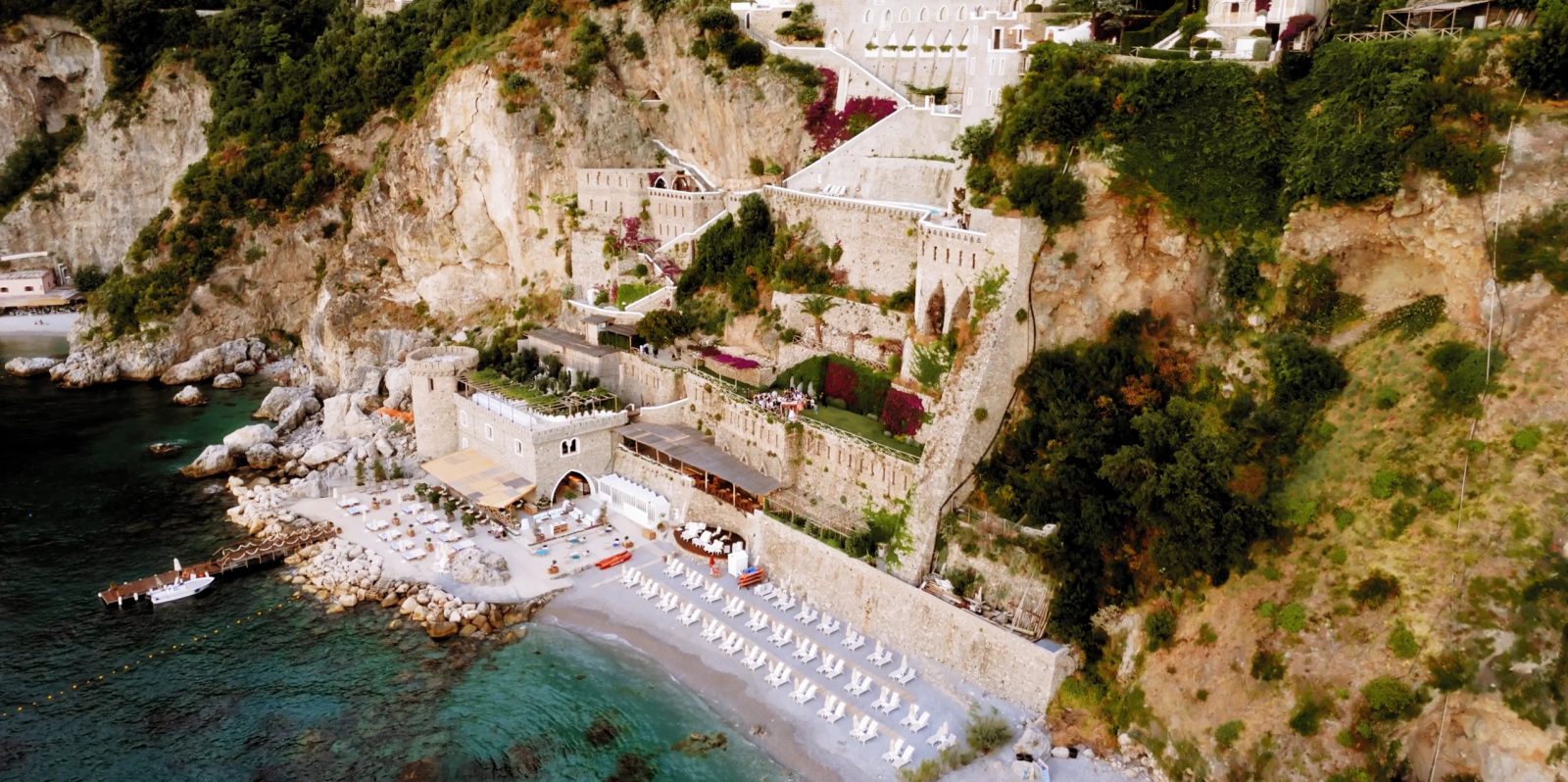
The Amalfi Coast is the opposite of a lake wedding. Instead of calm water at the bottom of the frame, you have cliffs, lemon terraces and towns stacked up the mountainside, with the sea far below. It is one of the most photographed coastlines in the world, and for a wedding film that is both the attraction and the problem: everything is beautiful, and everything is up or down a flight of steps.
We film weddings across Italy, the Amalfi Coast included. This guide covers what couples ask us most when they are choosing between Ravello, Positano and Amalfi, and what to plan for so the day runs smoothly on camera.
Ravello, Positano or Amalfi?
Ravello sits high above the sea, about 350 metres up, and has the grandest gardens on the coast. It is quieter than the towns on the water, and the views run all the way down the coast. If you want terraces, old villas and space for guests, start here.
Positano is the postcard: pastel houses falling down to a beach. It is beautiful, steep and busy, and it works best for smaller weddings, elopements and portraits rather than large dinners.
Amalfi is the historic town, with the cathedral of Sant'Andrea at the top of its long staircase. It sits at sea level, has the best ferry connections, and gives you a real town square for photos.
Praiano, Furore and Conca dei Marini are smaller and calmer, and some of the most private venues on the coast are there.
Venues worth knowing
Villa Cimbrone, Ravello. A villa that dates back at least to the eleventh century, rebuilt in a mix of Gothic, Moorish and Venetian styles after Ernest Beckett, Lord Grimthorpe, bought it in 1904. Its Terrace of Infinity, a belvedere lined with marble busts over the sea, is one of the most famous views in Italy. It is now a hotel.
Villa Rufolo, Ravello. Thirteenth century, built by the Rufolo merchant family and restored in the 1800s by Francis Nevile Reid. Wagner visited in 1880 and used its garden as the model for Klingsor's magic garden in Parsifal, and its lower garden still hosts the Ravello festival concerts. It is better known for portraits than ceremonies.
Belmond Hotel Caruso, Ravello. An eleventh century palace that has been a hotel since 1893, with gardens and an infinity pool on the cliff edge.
Palazzo Avino, Ravello. A thirteenth century palazzo, opened as a hotel in 1997, with forty three rooms.
Villa Eva, Ravello. A late Liberty-style villa with a park of old trees and views on all sides. Ceremonies happen under the trees, including non-Catholic ones, which makes it popular with international couples.
Le Sirenuse, Positano. An eighteenth century palazzo of the Sersale family, a hotel since 1951, right in the middle of the Positano view.
Monastero Santa Rosa, Conca dei Marini. A monastery founded in 1681, where the nuns created the sfogliatella Santa Rosa pastry. It was restored as a twenty-room hotel with gardens and an infinity pool over the sea.
Where you can legally marry
Civil ceremonies happen at specific places approved by each town. Positano uses a municipal terrace with sea views. Amalfi uses a former twelfth century Benedictine convent. Ravello holds civil ceremonies at Palazzo Tolla, the town hall, or in the Principessa di Piemonte gardens, with an indoor wedding room in a twelfth century palace as the rainy-day option, according to the Positano tourism guide.
Private villas and hotels generally host symbolic ceremonies. Many couples do the legal part at home, or at the town hall the day before, and hold the ceremony that matters at their venue. Book town hall slots early: a year ahead is normal on this coast.
Logistics that shape the film
Steps. Almost everything on the coast involves stairs, often hundreds of them. Plan where elderly guests are seated, keep the ceremony and dinner close together, and make sure the photographer and videographer know the walking routes before the day. Carrying equipment up and down Positano takes longer than anyone expects.
Roads. The coast road, the SS163, is narrow and slow, and in busy periods the authorities restrict non-resident cars by odd and even number plates. Hotel guests, taxis and hired cars with drivers are usually exempt, but the rules and dates change each year, so check the current ordinance. Positano also charges larger vehicles to pass through its limited traffic zone. In practice, book drivers and don't plan for guests to drive themselves.
Boats. Ferries and private boats are often faster than the road and give the best footage of the day: the town rising above the water as you arrive. Rough sea cancels them, so always keep a road backup.
Airports. Naples airport is the usual arrival point, roughly an hour and a quarter to an hour and a half by car to Positano or Ravello outside peak traffic, and longer in summer. Salerno airport is closer to the eastern end of the coast.
Heat and crowds. July and August are hot and very busy. May, June and September are the months we would recommend, with ceremonies in the late afternoon and portraits in the last hour before sunset.
Drones. Drone flights in Italy fall under ENAC and EU rules, and towns this dense often have restrictions. We clear any drone shot with the venue and check the airspace well before the day.
How the light works here
Positano and Amalfi face south, so the light is strong for most of the day and bounces off pale walls and the sea. Midday portraits rarely look good. We plan the important moments for late afternoon, when the sun drops behind the headlands and the towns turn warm. Ravello is high enough that the evening light holds longer, and the terraces give a clean horizon line for sunset.
Frequently asked questions
Where is the best place to get married on the Amalfi Coast?
For larger weddings and gardens, Ravello. For the classic view and smaller celebrations, Positano. For a church wedding and easy logistics, Amalfi.
Can we have a legal wedding on the Amalfi Coast as foreigners?
Yes. You need a nulla osta from your embassy, two witnesses and an interpreter if either of you doesn't speak Italian. Civil ceremonies take place at venues approved by each town, such as Ravello's town hall or gardens.
When is the best time for an Amalfi Coast wedding?
May, June and September. July and August are hottest and busiest, and the coast road is at its slowest.
Do you film on the Amalfi Coast?
Yes. We film across Italy, and travel and accommodation are included in our prices anywhere in the country. Weddings start from €4,500.
Planning a wedding in Ravello, Positano or Amalfi? Get in touch with your venue and date, and watch our films on the work page. If you are still choosing a region, our guide to wedding locations in Italy compares the lakes, Tuscany, the coast and the cities.
Other stories you may like

How to Elope in Italy: Places, Paperwork and Planning
A practical guide to eloping in Italy: the best places, legal and symbolic options, Dolomites rules, timing, and how an elopement film works.
Wedding Locations in Italy: Where to Get Married
Lakes, hills, coast or city? A filmmaker's comparison of the best wedding locations in Italy, with real venues we have filmed and how to choose.